The two methods of artifical DNA replication, or "cloning", have similarites as follows:
- They both intend to produce large numbers of the gene they replicate
- They both are executed with the intent of replicating a gene elsewhere.
Differences:
Vector Cloning:
- Is done with the intention of further expressing the gene
- Uses the restriction enzymes to determine the gene of interest, then inserted into the plasmid.
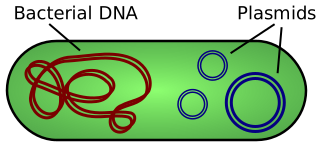 |
| Figure 1.1: Plasmids in Bacteria |
- The gene of interest, when done correctly, is expressed in the given object.
This differs from PCR because:
- PCR requires a PCR machine
- PCR has no intention of expressing the gene, in fact, PCR may not even be a gene that it targets
- PCR hs hydrogen bonds broken with heat
- DNA primers are then introduced, unlike DNA replication, where RNA primers are introduced. The DNA primer is man-made.
 |
| Figure 1.2: PCR Process |
- The growth of DNA with PCR is exponential.
- Stops with cooling process
DNA Sequencing
-DNA Sequencing requires radioactive primers, in order for them to be visible to the naked eye,unlike PCR
-The signal to stop in DNA Sequencing is always a ddNTP - they lack an OH to add on to the next nucleotide
- When incomplete digestion is wanted, only a small amount of ddNTP is added, thus not creating enough termination signals.
<- A short & sweet video to help reinforce your knowledge of DNA Sequencing :)

No comments:
Post a Comment