Recently there has been a ban enforced on the sale of shark fin. This post is to exhibit my views on this ban.
Although the sale of shark fins has been grossly taken advantage of by illegal fisherman off the coast of certain countries around the world, the banning of sharkfins in Toronto still is a slight mystery to me. City hall has not decided to ban the whole shark, yet only the fin, triggering, in my mind, certain qualities of racism within City hall. The reason I claim this is simple; there is only the fin banned from the market, yet other parts of the shark are allowed to thrive. I believe if the city wants to ban shark fin, the best option the city could make is to ban the entire shark itself, as opposed to only the fin.
Nonetheless, banning the fin itself does have its benefits to Mother Nature. I'm sure the amount of illegal shark hunting will go down after the ban takes effect. Nothing political, no matter how beneficial, comes cleanly without criticism; this much is obvious.
Monday, January 16, 2012

Clothespin Lab
 The clothespin lab was an experiment conducted to determine how many times my partners Timothy, Charlie, Peter, and Mohammed could open and close a clothespin in 30 seconds. The added challenge was that we had to go for 6 rounds with little rest in between rounds. Some interesting conclusions were drawn based on several attempts with several different participants:
1. the dominant hand always had more clicks compared to the round with the non-dominant hand.
2. The number of clicks was inversely proportional to the round number.
3. The last round always seemed to have more clicks than the second last round.
4. The pain was documented to be directy proportional to the round number
This lab was a great introduction to cellular respiration, and also a great chance for our group to exhibit our extraordinary finger strength :)
Thursday, October 20, 2011
Metabolism & Enzymes
Here are 20 basic points on metabolism and enzymes:
1. First law of thermodynamics: The total amount of energy existing is constant. Energy can be added, removed, transfered, yet cannot be destroyed.
2. Second law of thermodynamics: Entropy (randomness) always increases. The free energy in the universe is constantly decreasing, entropic energy is always increasing. Free energy is used to determine order. The universe always leads towards entropy.
3. Third law of thermodynamics: Absolute Zero (-273.15 degrees celsius) is the lowest temperature hypothecially achievable. At this temperature, matter will cease to vibrate, and thus cease to exist.
4. Molecules store energy through their bonds. Ergo, it's called bond energy. Bond energy is the minimum energy required to break one mol of bonds between two types of atoms. A molecule with a larger bond (e.g. double bond) will generally have a larger amount of bond energy stored than a molecule with a smaller bond (e.g. single bond)
5. Exothermic reaction: when more energy is released during bond FORMATION than bond BREAKING, leading to a output of energy.
6. Endothermic reaction: when more energy isabsorbed to break the bonds than to form the new bonds, leading to an absorption of energy.
7. Spontaneous changes? Two factors determine a spontaneous change: Energy and Entropy. Exothermic reactions are favoured, and those that lead to an increase in entropy are also favoured. Thus, these will always occur spontaneously. However, those exothermic reactions that lead to a decrease in entropy will not be spontaneous at high temperatures. Conversly, endothermic reactions are not favoured by the universe, and neither are decreases in entropy, thus they are not spontaneous at all temperatures. Changes proceed only with a net input of energy. But, an endothermic reaction with an increase in entropy will be spontaneous at high temperatures, (still not spontaneous at low temperatures)
8. Free energy: Energy that can do work. A change in free energy leads to an increase in entropy. All sources of free enegy in theworld, according to entropy, will become completely disordered and useless.
9. Exergonic reaction: Change in Gibbs free energy (decrease; negatively). Spontaneous
10. Endergonic reaction: Change in Gibbs free energy (increase; positively). Non-spontaneous.
11. For example, in cellular respiration, 2870 kJ of free energy per mol of glucose processed is made available to the cell for performing cellular work, thus change in G = -2870 kJ/mol used
In photosynthesis, 2870 k of work is done by light energy for every mol of glucose formed in the overall process. This amount of free energy is absorbed in the overall processby te glucose, thus change in G = 2870 kJ/mol formed
12. ATP is the main source of free energy in living cells. When cell requires free energy to drive an endergonic raction, an enzyme called ATPase catalyzes the hydrolysi of
13. ATP contains adenine, attached to 5 carbon sugar ribose, which is bound to THREE phosphate groups (tri)
14. Redox reactions: LEO the lion goes GER = Losing Electrons is Oxidation, Gaining electrons is Reduction.
15. The substance that provides the electron is called the reducing agent; the substance that takes the electron is called the oxidizing agent.
16. Enzymes speed up endergonic and exergonic reactions by lowering the activation energy, but does not change the value of G.
17. To inhibit enzymes, there are inhibitors that are designed to stop an enzyme's actions.
18. The competitive inhibitor are similar to the enzyme's substrate (the reactant tht the enzyme acts on when catalyzing). They block the enzyme's activie side and prevent binding. Non-competitive inhibitors aren't shaped like the enzyme; they attach to anoher site and changes te enzyme's shape.
19. Allosteric sites are receptor sites that give room to substance to bind to in order tostimulate an enzyme's ability.
20. Feedback inhibition is a a method of metabolic control that a product formed later in a sequence of reactions alloseterically inhibits an enzyme that catalyuzes a reaction occurring earlier in the process..?
1. First law of thermodynamics: The total amount of energy existing is constant. Energy can be added, removed, transfered, yet cannot be destroyed.
2. Second law of thermodynamics: Entropy (randomness) always increases. The free energy in the universe is constantly decreasing, entropic energy is always increasing. Free energy is used to determine order. The universe always leads towards entropy.
3. Third law of thermodynamics: Absolute Zero (-273.15 degrees celsius) is the lowest temperature hypothecially achievable. At this temperature, matter will cease to vibrate, and thus cease to exist.
4. Molecules store energy through their bonds. Ergo, it's called bond energy. Bond energy is the minimum energy required to break one mol of bonds between two types of atoms. A molecule with a larger bond (e.g. double bond) will generally have a larger amount of bond energy stored than a molecule with a smaller bond (e.g. single bond)
5. Exothermic reaction: when more energy is released during bond FORMATION than bond BREAKING, leading to a output of energy.
6. Endothermic reaction: when more energy isabsorbed to break the bonds than to form the new bonds, leading to an absorption of energy.
7. Spontaneous changes? Two factors determine a spontaneous change: Energy and Entropy. Exothermic reactions are favoured, and those that lead to an increase in entropy are also favoured. Thus, these will always occur spontaneously. However, those exothermic reactions that lead to a decrease in entropy will not be spontaneous at high temperatures. Conversly, endothermic reactions are not favoured by the universe, and neither are decreases in entropy, thus they are not spontaneous at all temperatures. Changes proceed only with a net input of energy. But, an endothermic reaction with an increase in entropy will be spontaneous at high temperatures, (still not spontaneous at low temperatures)
8. Free energy: Energy that can do work. A change in free energy leads to an increase in entropy. All sources of free enegy in theworld, according to entropy, will become completely disordered and useless.
9. Exergonic reaction: Change in Gibbs free energy (decrease; negatively). Spontaneous
10. Endergonic reaction: Change in Gibbs free energy (increase; positively). Non-spontaneous.
11. For example, in cellular respiration, 2870 kJ of free energy per mol of glucose processed is made available to the cell for performing cellular work, thus change in G = -2870 kJ/mol used
In photosynthesis, 2870 k of work is done by light energy for every mol of glucose formed in the overall process. This amount of free energy is absorbed in the overall processby te glucose, thus change in G = 2870 kJ/mol formed
12. ATP is the main source of free energy in living cells. When cell requires free energy to drive an endergonic raction, an enzyme called ATPase catalyzes the hydrolysi of
13. ATP contains adenine, attached to 5 carbon sugar ribose, which is bound to THREE phosphate groups (tri)
14. Redox reactions: LEO the lion goes GER = Losing Electrons is Oxidation, Gaining electrons is Reduction.
15. The substance that provides the electron is called the reducing agent; the substance that takes the electron is called the oxidizing agent.
16. Enzymes speed up endergonic and exergonic reactions by lowering the activation energy, but does not change the value of G.
17. To inhibit enzymes, there are inhibitors that are designed to stop an enzyme's actions.
18. The competitive inhibitor are similar to the enzyme's substrate (the reactant tht the enzyme acts on when catalyzing). They block the enzyme's activie side and prevent binding. Non-competitive inhibitors aren't shaped like the enzyme; they attach to anoher site and changes te enzyme's shape.
19. Allosteric sites are receptor sites that give room to substance to bind to in order tostimulate an enzyme's ability.
20. Feedback inhibition is a a method of metabolic control that a product formed later in a sequence of reactions alloseterically inhibits an enzyme that catalyuzes a reaction occurring earlier in the process..?
Monday, October 17, 2011
Need-to-knows about Biotech!
In no particular order...
RFLP
STANDS FOR: Restriction Fragment Length Polymorphism (or patterns)
IS USED FOR: Determining DNA matches through gel electrophorsis
sort of like gel electrophorsis... except COMPLETE DIGESTION ONLY
takes advantage of DNA's negative charge; puts nylon membrane with positively charged electrode behind it. The DNA from the gel will then transfer OUT of the gel and INTO the nylon membrane.
Once in the nylon membrane, the membrane must be copied via x-ray in order for the DNA to be expressed.
"autoradiogram" is the final result.
Vector Cloning
- Used when wanting to express gene
- Antifreeze in fish expressed in tomato is a good example
1. isolate gene
2. cut with scissors (restricton enzymes)
3. attach gene of interest by sticky ends into plasmid
4. Inject plasmid into bacteria
5. "Infect" targets with new bacteria, thus expressing the gene in another living object.
PCR
PCR cloning is used in the laboratory; in vitro
- DNA is heated to remoe hydrogen bonds, forming 2 single strands
- The DNA primers are then attached, acting as RNA primers during DNA replication in nature
- The Taq polymerase then comes in and acts as the DNA polymerase III found in nature.
- The segments form 5-3; copy 3-5
- The DNA then starts replicating at an exponential rate
- Does not start targeting until after third copy.
After 29-30 cycles, it reaches 1 million copies; requires only one day
DNA Sequencing:
- Discovered by Sanger
- Similar to Gel electrophoresis
- Takes advantage of negative charge of DNA
- Requires Nylon Membrane to be x-rayed
RFLP
STANDS FOR: Restriction Fragment Length Polymorphism (or patterns)
IS USED FOR: Determining DNA matches through gel electrophorsis
sort of like gel electrophorsis... except COMPLETE DIGESTION ONLY
takes advantage of DNA's negative charge; puts nylon membrane with positively charged electrode behind it. The DNA from the gel will then transfer OUT of the gel and INTO the nylon membrane.
Once in the nylon membrane, the membrane must be copied via x-ray in order for the DNA to be expressed.
"autoradiogram" is the final result.
Vector Cloning
- Used when wanting to express gene
- Antifreeze in fish expressed in tomato is a good example
1. isolate gene
2. cut with scissors (restricton enzymes)
3. attach gene of interest by sticky ends into plasmid
4. Inject plasmid into bacteria
5. "Infect" targets with new bacteria, thus expressing the gene in another living object.
PCR
PCR cloning is used in the laboratory; in vitro
- DNA is heated to remoe hydrogen bonds, forming 2 single strands
- The DNA primers are then attached, acting as RNA primers during DNA replication in nature
- The Taq polymerase then comes in and acts as the DNA polymerase III found in nature.
- The segments form 5-3; copy 3-5
- The DNA then starts replicating at an exponential rate
- Does not start targeting until after third copy.
After 29-30 cycles, it reaches 1 million copies; requires only one day
DNA Sequencing:
- Discovered by Sanger
- Similar to Gel electrophoresis
- Takes advantage of negative charge of DNA
- Requires Nylon Membrane to be x-rayed
Biotech: Vector Cloning vs PCR, DNA Sequencing
Vector Cloning, PCR (Polymerase Chain Reaction), & DNA Sequencing
The two methods of artifical DNA replication, or "cloning", have similarites as follows:
- They both intend to produce large numbers of the gene they replicate
- They both are executed with the intent of replicating a gene elsewhere.
Differences:
Vector Cloning:
- Is done with the intention of further expressing the gene
- Uses the restriction enzymes to determine the gene of interest, then inserted into the plasmid.
- Plasmid is then introduced to bacteria. The plasmid has the opportunity to reproduce along with the bacteria.
- The gene of interest, when done correctly, is expressed in the given object.
This differs from PCR because:
- PCR requires a PCR machine
- PCR has no intention of expressing the gene, in fact, PCR may not even be a gene that it targets
- PCR hs hydrogen bonds broken with heat
- DNA primers are then introduced, unlike DNA replication, where RNA primers are introduced. The DNA primer is man-made.
- Taq polymerase is introduced after the primers anneal (instead of DNA poly III) because of the level of heat the DNA is subjected to.
- The growth of DNA with PCR is exponential.
- Stops with cooling process
DNA Sequencing
-DNA Sequencing requires radioactive primers, in order for them to be visible to the naked eye,unlike PCR
-The signal to stop in DNA Sequencing is always a ddNTP - they lack an OH to add on to the next nucleotide
- When incomplete digestion is wanted, only a small amount of ddNTP is added, thus not creating enough termination signals.
<- A short & sweet video to help reinforce your knowledge of DNA Sequencing :)
The two methods of artifical DNA replication, or "cloning", have similarites as follows:
- They both intend to produce large numbers of the gene they replicate
- They both are executed with the intent of replicating a gene elsewhere.
Differences:
Vector Cloning:
- Is done with the intention of further expressing the gene
- Uses the restriction enzymes to determine the gene of interest, then inserted into the plasmid.
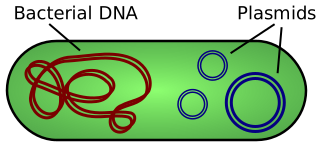 |
| Figure 1.1: Plasmids in Bacteria |
- The gene of interest, when done correctly, is expressed in the given object.
This differs from PCR because:
- PCR requires a PCR machine
- PCR has no intention of expressing the gene, in fact, PCR may not even be a gene that it targets
- PCR hs hydrogen bonds broken with heat
- DNA primers are then introduced, unlike DNA replication, where RNA primers are introduced. The DNA primer is man-made.
 |
| Figure 1.2: PCR Process |
- The growth of DNA with PCR is exponential.
- Stops with cooling process
DNA Sequencing
-DNA Sequencing requires radioactive primers, in order for them to be visible to the naked eye,unlike PCR
-The signal to stop in DNA Sequencing is always a ddNTP - they lack an OH to add on to the next nucleotide
- When incomplete digestion is wanted, only a small amount of ddNTP is added, thus not creating enough termination signals.
<- A short & sweet video to help reinforce your knowledge of DNA Sequencing :)
Saturday, October 1, 2011
10 important topics on the classic genetics test
1. Famous scientists associated with genetics - Franklin, Griffith, Chargoff, to name a few.
2. The DNA structure: antiparallel and and shaped as a double helix
3. Purines = Adanine and Guanine; Pyramidine = Thymine and Cytosine
4. Deoxyribose and Oxyribose sugars: Oxyribose has an extra oxygen on its second carbon
5. DNA is double stranded and found in the nucleus, RNA is double stranded and found both in the nucleus and cytoplasm
6. RNA is found in many different versions, mRNA, tRNA, premRNA.
7. Procedure of protein synthesis: replication->transcription->translation
8. DNA is always replicated 5' - 3'
9. For transcription, start by finding the TATA box, which is labelled 5'-3.
10. For translation, remember each amino acid begins with Met, because start codon is always AUG
11. Good luck :)
2. The DNA structure: antiparallel and and shaped as a double helix
3. Purines = Adanine and Guanine; Pyramidine = Thymine and Cytosine
4. Deoxyribose and Oxyribose sugars: Oxyribose has an extra oxygen on its second carbon
5. DNA is double stranded and found in the nucleus, RNA is double stranded and found both in the nucleus and cytoplasm
6. RNA is found in many different versions, mRNA, tRNA, premRNA.
7. Procedure of protein synthesis: replication->transcription->translation
8. DNA is always replicated 5' - 3'
9. For transcription, start by finding the TATA box, which is labelled 5'-3.
10. For translation, remember each amino acid begins with Met, because start codon is always AUG
11. Good luck :)
Deaf by Design
The world today provides technology unimaginable to mankind decades ago. It is with certainty that citizens of the deaf world - especially those committed since birth - had never believed they'd have the opportunity of hearing. With this said, should the deaf who are provided with this chance take the leap into the hearing world?
In my opinion, the ability to hear is an indefinite advantage - one that many people take for granted. As the opportunity for the deaf grows larger, I do believe that they should indeed take the opportunity to hear. An opportunity for any advantage should be taken, and the ability to hear for those who were born deaf should be taken, as it will open doors for many prosperities to come.
In my opinion, the ability to hear is an indefinite advantage - one that many people take for granted. As the opportunity for the deaf grows larger, I do believe that they should indeed take the opportunity to hear. An opportunity for any advantage should be taken, and the ability to hear for those who were born deaf should be taken, as it will open doors for many prosperities to come.
Subscribe to:
Comments (Atom)